
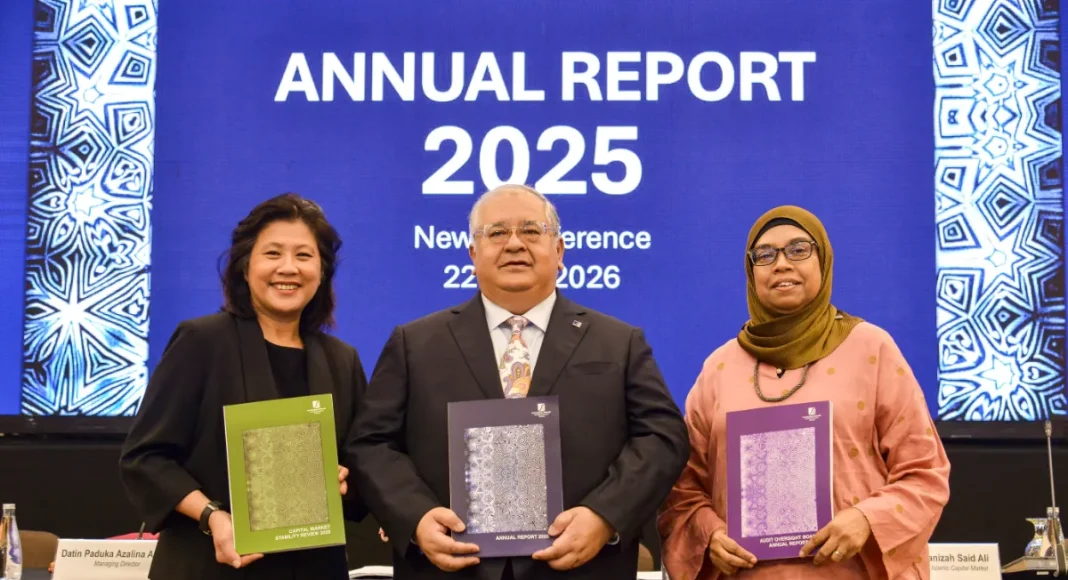
KUALA LUMPUR: The Securities Commission Malaysia (SC) is stepping up efforts to deepen market liquidity, expand exchange-traded funds (ETF) and attract long-term capital flows as part of a broader push to strengthen the country’s capital market resilience amid global uncertainty.
SC chairman Datuk Mohammad Faiz Azmi said a key priority is to significantly grow Malaysia’s ETF ecosystem, which currently lags regional peers, as a means to position the country as a gateway for regional investments.
“Malaysia currently has only 13 ETFs, compared to hundreds in markets like (South) Korea and China. We need to grow this segment because ETFs can allow global investors to access not just Malaysian assets, but also regional opportunities through Malaysia,” he told a press conference after releasing the SC Annual Report 2025 today.
Mohammad Faiz said the regulator is exploring the development of regional and syariah-compliant ETF, including the possibility of screening stocks across Asean markets to broaden the investment universe.
“This is part of the strategy to attract larger pools of capital. It doesn’t have to be limited to Malaysian companies. We can intermediate regional investments through Malaysia,” he added.
Mohammad Faiz noted that while global capital flows are shifting amid heightened geopolitical and economic uncertainties, Malaysia must position itself to attract more stable, long-term investors rather than rely on short-term foreign inflows.
“Foreign funds can be quite fickle. What we need are long-term investors who are willing to stay invested for sustainable returns,” he said, adding that this includes strengthening domestic institutional participation.
On market depth, the SC acknowledged that trading activity has softened despite overall market growth, and said efforts are underway to improve liquidity and participation.
The Malaysian capital market grew 3.2% to a record RM4.3 trillion in 2025, up from RM4.2 trillion in 2024, supported by higher bond issuances and fund management inflows, according to the report.
However, average daily trading value declined 19.7% to RM2.76 billion, reflecting more cautious investor sentiment amid global volatility.
Mohammad Faiz said the SC is also focusing on enhancing corporate value creation through its “MY Value Up” programme, which targets the top listed companies representing about 80% of total market capitalisation.
“We are not here to run companies, but to ensure they have the right information and frameworks to improve their valuation and attractiveness to investors,” he said.
The programme will initially be voluntary, with engagement sessions and workshops planned from May, before potential broader implementation in the coming years.
At the same time, the regulator is prioritising efforts to close the financing gap for small and medium enterprises (SMEs), estimated at RM268 billion.
“This gap remains significant. Alternative financing, private equity, venture capital and private credit will play a bigger role in bridging this,” Mohammad Faiz said.
He added that the SC is open to allowing qualified fund managers, particularly those linked to banking groups, to extend credit to SMEs using funds from high-net-worth investors.
“This creates another channel of financing while ensuring proper risk management,” he said.
The SC is targeting to mobilise about RM130 billion over five years through a combination of public and private funding initiatives.
Beyond financing, the regulator is also advancing reforms under the Capital Market Masterplan 2026–2030, including enhancements to the Main, ACE and LEAP markets, as well as frameworks for digital assets and tokenisation of securities.
On digital markets, Mohammad Faiz said initiatives such as digital asset ETF and improved regulatory clarity are expected to support future growth areas.
Meanwhile, Malaysia’s Islamic capital market continued to expand, rising 4.31% to RM2.7 trillion in 2025, reinforcing the country’s position as a global leader in syariah-compliant finance.
The fund management industry saw assets under management increase 6.9% to a record RM1.14 trillion, while total funds raised in the capital market surged 35.4% to RM187.7 billion.
Despite global headwinds, Mohammad Faiz maintained that the Malaysian capital market remains fundamentally resilient. “In a volatile environment, stability is a strength. The focus now is on building depth, competitiveness and long-term sustainability,” he said.