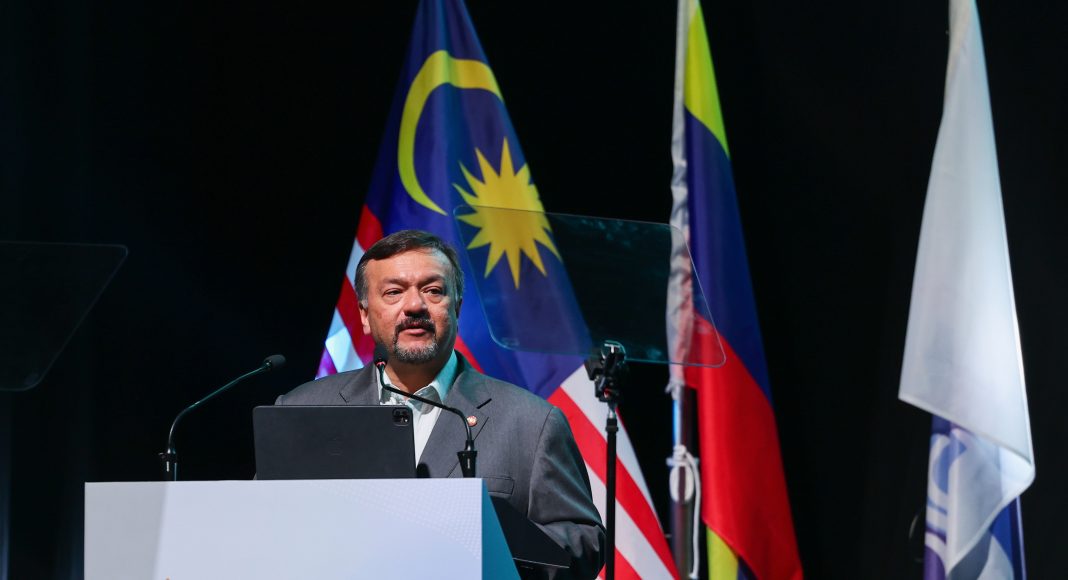
KUALA LUMPUR: The accountancy profession must play a more active role in guiding businesses and policymakers through an increasingly complex global landscape, said Finance Minister II Amir Hamzah Azizan.
He said accountants must move beyond their traditional role as compliance gatekeepers to become strategic advisers driving value creation and national competitiveness.
“As global investors and supply chain partners reassess their capital and look at building partnerships, they are looking for economies that offer reliability, transparency, sound governance and professional credibility. Malaysia must compete not only on cost, infrastructure and incentive, but also trust and confidence,“ Amir Hamzah said in his speech at the MIA International Accountants Conference 2026 today.
Highlighting the central role of ethics, he said technical competence must go hand in hand with integrity and professional scepticism to preserve the trust placed in the profession.
“Trust is what gives the profession its standing. Accountants play a vital role in strengthening Malaysia’s credibility and investor confidence through financial reporting, governance and assurance.”
Amir Hamzah said the evolving global environment shaped by geopolitical tensions, supply chain realignments, technological disruptions, climate risks and shifting investor expectations is redefining how economies grow and compete.
For Malaysia, he noted, this presents both challenges and opportunities, requiring stronger fiscal discipline, improved public service delivery and sustained efforts to attract high-value investments.
Amir Hamzah said the accountancy profession plays a critical role in ensuring that reforms are carried out with credibility, accountability and trust.
“Today, accountancy professionals are transcending their traditional roles as preparers of financial statements or guardians of compliance. At their best, accountants are strategic advisors, stewards of value and trusted professionals who help organisations make better decisions, manage risks, allocate resources responsibly and communicate performance credibly.”
Amir Hamzah highlighted digital transformation as one of the most significant forces reshaping economies, noting that its success depends on reliable data, secure systems, effective controls and sound professional judgement.
He welcomed ongoing efforts by the Malaysian Institute of Accountants (MIA) to strengthen digital readiness within the profession, including initiatives such as the Digital Tech Award 2026 and the SMP Digital Accelerator Programme.
At the same time, he stressed that accountants must rise to the growing importance of sustainability, as climate risks, resource efficiency, energy transition and social impacts become increasingly tied to long-term value creation and access to capital.
“As sustainability reporting and assurance continue to develop, the accountancy profession has an important role in ensuring that sustainability information is credible, comparable and decision-useful,” Amir Hamzah said.
He added that initiatives such as the MIA Sustainability Roadmap and Sustainability Certificate would help equip professionals with the necessary skills to support Malaysia’s sustainability agenda.
Amir Hamzah also underscored the need for prudent management of limited fiscal resources, noting that “every ringgit must be well used” amid supply shocks and rising expectations.
He said accountants contribute directly to improving decision-making across the economy through budgeting, financial management, tax governance, audit and risk management, while also supporting efforts to strengthen revenue integrity and reduce leakages.
The rollout of e-invoicing, he added, will enhance compliance, transparency and confidence in financial systems, particularly as Malaysia moves towards more targeted subsidies and disciplined public spending.
Amir Hamzah pointed to Malaysia’s leadership in Islamic finance, where the focus is increasingly expanding beyond financial performance to include impact and accountability.
At the conference, an industrial guide on impact monitoring and reporting for Islamic social finance jointly developed by the World Bank and the MIA was launched to strengthen impact measurement and reporting standards.
Amir Hamzah said the guide is timely, as it reinforces Malaysia’s position as a thought leader in Islamic finance while enhancing discipline, credibility and trust in impact reporting.
He added that collaboration between the government, professional bodies, businesses and educators will be essential to ensure the profession remains relevant and capable of supporting Malaysia’s development.
“As Malaysia prepares for its next stage of growth, the country needs accountants who are ready to lead, advise and serve,” Amir Hamzah said, adding that the profession will continue to play a central role in advancing a resilient, competitive and trusted Malaysia.